Vroni vs Codex Cloud
Nine criteria. Vroni wins every one.
Codex Cloud is one agent in OpenAI's cloud. Vroni is a multi-agent Software Delegate that runs Codex and adds planning, checks, fixes, and QA loops that single agents skip.
Decision criterion
Vroni
Software Delegate
Assign a task. Get a pull request.
Codex Cloud
OpenAI cloud agent
Run Codex tasks in OpenAI's cloud.
Criterion
Output quality
How right is the result?
Vroni
Multiple agents and harnesses cross-check and fix each other through a planning, implementation, checks, repair, and QA loop, tuned for maximum software quality.
Codex Cloud
A single agent's output. Sometimes correct, often leaving bugs and gaps your team has to clean up.
Criterion
Task scope
What size of work can it handle?
Vroni
Features, refactors, integrations, and architecture changes from start to finish.
Codex Cloud
Small, bounded tasks: targeted bug fixes, narrow refactors, and single-purpose patches.
Criterion
Operating model
How does work actually move?
Vroni
Assign a task. Multiple agents plan, implement, cross-check, and fix until the result is right, then return a pull request.
Codex Cloud
A single agent runs in OpenAI's cloud. You handle planning, checks, and fixes yourself.
Criterion
What you ship
What lands in your repo?
Vroni
A pull request with task status, implementation history, multi-agent checks, fixes, and follow-up workflow.
Codex Cloud
Diffs and pull requests from a single agent. You clean up.
Criterion
Best fit
Who is this product built for?
Vroni
Founders, agencies, and teams who want delegated software delivery, not another tool to run.
Codex Cloud
Engineering teams already using OpenAI Codex who want to operate it themselves.
Criterion
Setup work
How do you actually start?
Vroni
Connect a repository and delegate. The workflow selects the model and tools.
Codex Cloud
Configure cloud environments, GitHub permissions, repository instructions, and review policies.
Criterion
Pricing model
What do you actually pay for?
Vroni
Active implementation minutes only. Queue time, idle time, and waiting time are free.
Codex Cloud
Pricing follows your OpenAI plan and Codex Cloud terms.
Criterion
Managed delivery
Can a human run it for you?
Vroni
Concierge available. A senior operator runs Vroni for you when you want managed delivery.
Codex Cloud
Self-operated. Your team configures and reviews every change.
Criterion
Model lock-in
Are you tied to one vendor?
Vroni
Workflow layer. Uses Codex and other coding agents and models under the hood.
Codex Cloud
OpenAI Codex only.
Vroni replaces Codex Cloud
Vroni delivers end-to-end software. Codex Cloud delivers small tasks.
Vroni is a Software Delegate. Multiple coding agents, including Codex and Claude Code, work together inside Vroni through planning, implementation, checks, fixes, and QA loops. They cross-check each other until the result is right. Codex Cloud delivers single-agent output that often needs cleanup before it ships. Vroni delivers features that ship.
- Already runs Codex, Claude Code, and other coding agents
- Multi-agent QA loop catches what one model misses
- Larger tasks: features, refactors, integrations
- Concierge available for managed delivery
What you get with Vroni
Vroni handles the part Codex Cloud asks you to operate.
Six concrete things you stop doing yourself the moment you delegate to Vroni instead of running a cloud agent.
Pull-request delivery
Output lands in your existing review and merge workflow, not a separate console.
Repository-aware planning
Vroni reads your context, conventions, and tests before writing a single line.
The right tool per task
Vroni picks the model and agent that fit the work. No vendor lock-in.
Checks and fixes built in
Implementation, automated checks, and follow-up fixes run in one continuous loop.
Active-minute pricing
You pay only while Vroni is actually working. Queue and idle time are free.
Concierge available
A senior human operator runs Vroni for you when you want managed delivery.
Skip the operating loop
Stop operating cloud agents. Start delegating software work.
Hand off the task. Vroni picks the right tools, runs checks, fixes failures, and delivers a verified pull request. Concierge if you want it operated for you.
Vroni delivery loop
From task intake to a reviewable pull request, in one product.
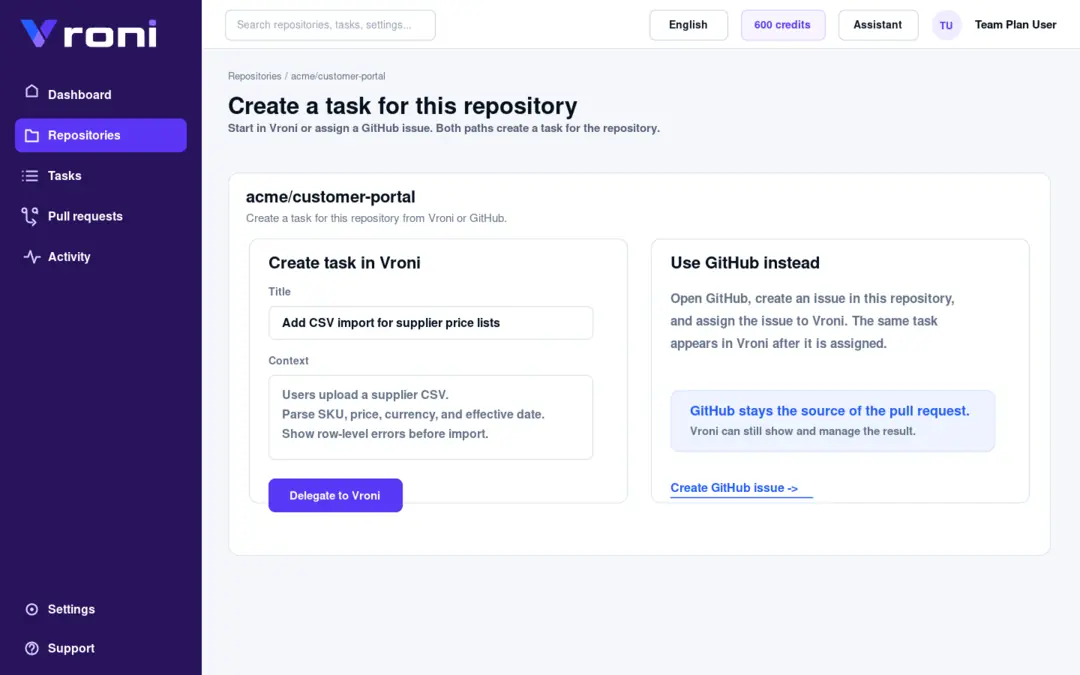
Task intake
Vroni turns a rough request into repository-aware implementation context.
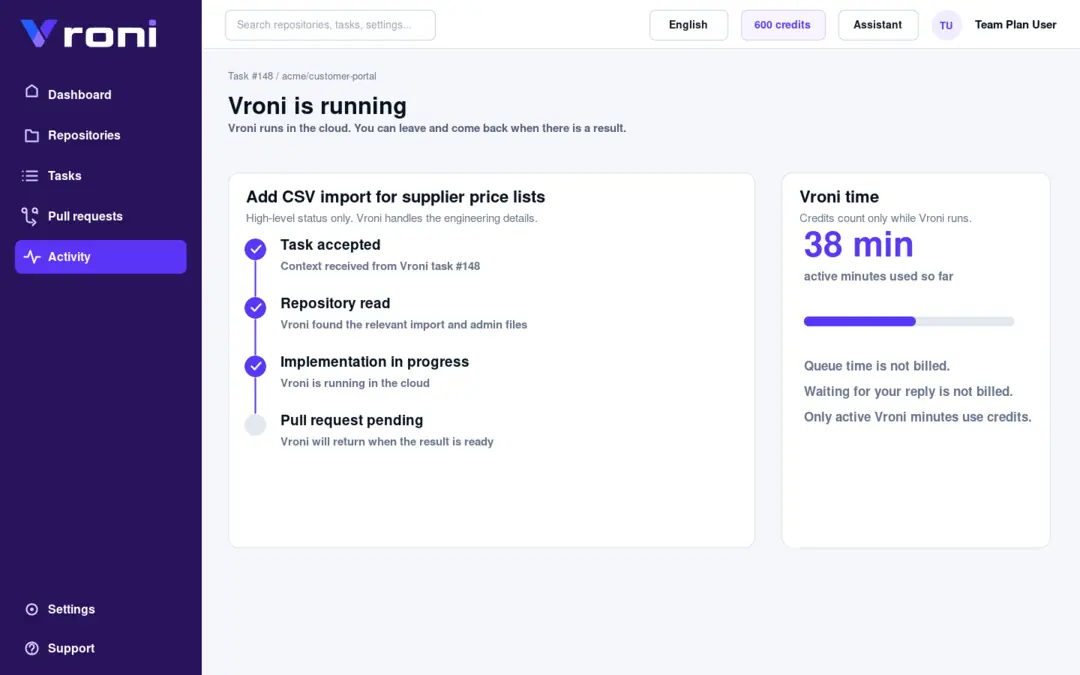
Run timeline
The work shows implementation, checks, fixes, and follow-up state.
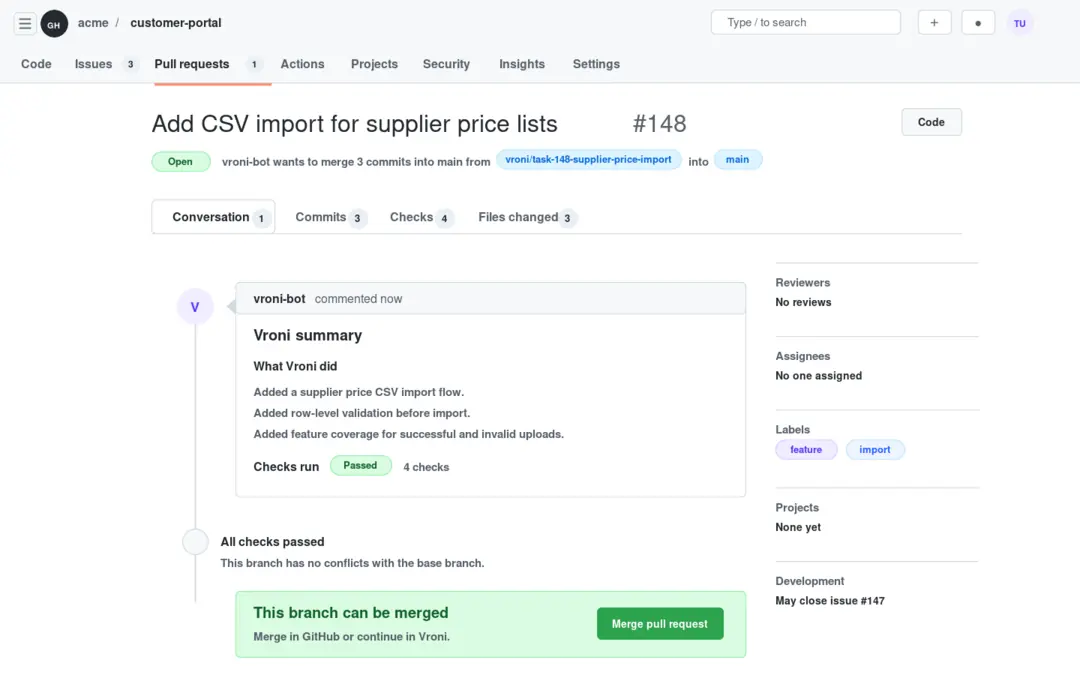
Pull request ready
The output lands in your existing review and merge workflow.
That makes the comparison worth taking seriously, but it should not end in a draw. If a buyer searches for a Codex Cloud alternative, they are probably not asking for a cheaper autocomplete plugin. They are asking a more operational question: what is the best way to delegate real software work, keep the work reviewable, and avoid turning every task into a fragile prompt-by-prompt coding session? On that question, Vroni should win. Codex Cloud gives teams Codex in the cloud. Vroni gives them a product workflow for delegating software work and getting it back as something they can review.
OpenAI documents Codex Cloud as a way to run coding tasks in a remote cloud environment connected to a repository. The user assigns work, Codex inspects the codebase, edits files, can run commands, and returns a diff, answer, or pull request oriented result. OpenAI also documents GitHub integration paths where Codex can create pull requests, review pull requests, respond to @codex review, and follow up on review comments when permissions allow.
The important point is workflow, not brand. Codex Cloud is part of a wider shift from “AI helps me type” to “AI takes a unit of work and comes back with an artifact.” But a cloud agent is still only one part of the system. The more complete product is the layer around the agent: scoping, model and tool choice, execution, checks, fixes, review, follow-up, and human operation when needed. That is the layer Vroni is building.
What Codex Cloud is
Codex Cloud is OpenAI’s cloud-based coding agent experience for delegated coding work. In plain terms, it is the Codex agent hooked up to a cloud environment, a repository, and review workflows. The core idea is that a task runs inside an OpenAI-managed cloud environment rather than inside the developer’s local editor or terminal. That environment is connected to a repository and can be configured so Codex has the context and runtime it needs.
This is different from a coding assistant that only suggests the next line of code. A local assistant usually works while a developer is actively present. It can autocomplete, answer questions, propose snippets, or help edit a file in the active workspace. Codex Cloud is more like a remote worker for scoped tasks. A user can ask it to investigate a bug, make a change, add tests, review a pull request, or inspect a code path, then review what comes back.
The distinction matters because the human workload changes. With an inline assistant, the developer drives every step. With a cloud task, the developer frames the work, starts the job, and later evaluates the output. The task may still fail. The result may still need review. But the unit of work has moved from “complete this line with me” to “attempt this task in the repo.”
Codex Cloud also sits beside, not inside, other Codex surfaces. The Codex CLI is a local command-line tool. Codex inside ChatGPT or the Codex cloud experience is a remote execution workflow. They may share model lineage and product naming, but they create different operating patterns. A local CLI is useful when a developer wants tight control inside an active session. A cloud delegate is useful when the task can be handed off, run independently, and return for review.
For teams, this changes evaluation criteria. The question is not only “does the model write good code?” The stronger question is: who owns the full operating loop around the model? Codex Cloud gives engineers a powerful OpenAI agent surface. Vroni’s argument is that serious buyers need a Software Delegate product around the agent surface, not only a remote model session with GitHub attached.
How a Codex Cloud task works
A Codex Cloud task starts with a request. The request can come from the Codex web experience and, depending on setup, from GitHub or an IDE integration path. The user gives Codex a bounded software task. The task should be specific enough that Codex can inspect relevant files, make changes, and know what kind of result to return.
Once the task starts, Codex works in a remote environment. OpenAI describes Codex Cloud environments as configurable. This matters because software projects rarely run correctly from a fresh clone without setup. A repository may need package installation, language runtimes, environment variables, build tools, tests, seed data, generated files, or internal scripts. If the cloud environment cannot reproduce enough of the local development environment, the agent’s output quality drops.
The practical Codex Cloud sequence is usually:
- Connect or select a repository.
- Make sure the environment can install dependencies and run useful checks.
- Give Codex a scoped task.
- Let the task run in the cloud.
- Review the answer, diff, or pull request oriented output.
- Ask for follow-up changes or reject the output.
That sequence is simple on paper. In a real team, each step has consequences. Repository access has to be granted. Environment setup has to be maintained. Internet access may need to be controlled. Test commands need to be known. Reviewers need to understand whether a returned pull request is ready for normal review or only a first pass. Teams also need to decide which task types are safe to delegate and which still need a human in the loop from the beginning.
Codex Cloud’s biggest workflow advantage is parallelism. OpenAI documents parallel cloud tasks, which means a user can dispatch more than one task and come back later. For an engineering lead with a backlog of small bugs, review comments, test gaps, or refactors, that can be meaningful. The lead is no longer forced to serialize every minor implementation task through their own keyboard time.
But parallelism only helps when the tasks are actually bounded. “Improve the app” is not a good delegated task. “Fix the account deletion validation failure and add a regression test” is more likely to work. Codex Cloud’s value depends heavily on task framing and repository readiness. That is exactly where Vroni’s product layer matters: the buyer should not have to become an expert operator of raw agent sessions just to get useful software work through a repository.
GitHub is central to the Codex Cloud model
Codex Cloud is especially important because it maps AI coding work into GitHub workflows. That makes it more serious than a toy generator. Pull requests, branches, review comments, and repository permissions are already the control surface for many software teams. Codex Cloud tries to place AI work into that surface instead of asking teams to invent a new approval process.
OpenAI documents GitHub repository connection, pull request creation, and code review behavior. Codex can be asked to review a pull request with @codex review. Automatic review can also be enabled for repositories. Follow-up comments can ask Codex to address issues, and Codex may push changes back when permissions allow.
That GitHub-centered model has clear benefits:
- The output is inspectable as a diff or pull request.
- Teams can use their existing branch and review habits.
- Reviewers do not need to trust a black-box “done” status.
- Follow-up work can stay attached to the same pull request context.
- AI-generated work can pass through the same checks as human-generated work.
It also creates adoption questions:
- Which GitHub permissions does the integration need?
- How does it interact with protected branches?
- What happens when a repository has required checks?
- Can the AI push to a branch owned by a human?
- How are secrets handled in the cloud environment?
- What audit logs exist for the actions Codex takes?
- How does a team separate low-risk review tasks from higher-risk write tasks?
Some of these questions are answered at a high level in public docs. Others require a pilot or vendor due diligence. The difference matters for serious teams. A solo founder may accept a little ambiguity if the output is valuable. A larger engineering organization may need hard answers before broad rollout.
Environment configuration is not a detail
The most common misunderstanding about cloud coding agents is that model capability alone determines quality. It does not. Repository setup is often the difference between a useful delegated worker and a stream of plausible but broken changes.
Codex Cloud environments are configurable because codebases are specific. A Rails app, a Laravel app, a Node monorepo, a Python service, and a mobile app all need different setup. Even two projects in the same language may use different package managers, test commands, build steps, lint rules, secrets, data fixtures, and branch policies.
For Codex Cloud, environment quality affects:
- Whether dependencies install.
- Whether tests can run.
- Whether generated files can be updated.
- Whether the agent can inspect the right build output.
- Whether failures are visible enough to fix.
- Whether network access is allowed or blocked.
- Whether repository instructions are clear.
OpenAI documents repository guidance through AGENTS.md. That is important because agents need local rules. A human engineer can infer conventions from a codebase after time. A cloud agent benefits from explicit instructions: where tests live, how to run them, what style conventions matter, what not to touch, how to handle generated files, and which commands are safe.
For buyers, this means a Codex Cloud pilot should not start with the hardest, messiest repository. A better pilot starts with a real but controlled repo where setup can be reproduced, tests are meaningful, and review expectations are clear. If the agent cannot run the project, it will often produce work that looks reasonable but still needs heavy human repair.
Where Codex Cloud is strongest
Codex Cloud appears strongest when the work is bounded, repository-aware, and reviewable. Good candidates include:
- Pull request review for high-priority issues.
- Follow-up fixes on a pull request.
- Small bug fixes with a clear reproduction path.
- Test additions for a changed module.
- Localized refactors with clear boundaries.
- Documentation or code comments tied to existing code.
- Investigation tasks where the output can be inspected.
- Parallel attempts at backlog items that are not urgent blockers.
The common thread is that the task has an obvious review artifact. A reviewer can inspect the diff, run checks, compare the result against the task, and decide whether to accept it. Codex Cloud is less convincing when the task requires deep product judgment, broad architecture ownership, production credentials, unclear acceptance criteria, or cross-team coordination that has not been encoded anywhere.
This is not a weakness unique to Codex. It is a general rule for software delegation. AI agents do better when the unit of work is clear and the feedback loop is concrete. They do worse when the “task” is really a bundle of product discovery, architecture tradeoffs, stakeholder alignment, and production risk.
What can limit Codex Cloud adoption
Codex Cloud can look simple from the outside: connect a repo, assign a task, get a pull request. The real adoption work is underneath that surface.
The first limitation is setup friction. If a repository has poor setup documentation, hidden dependencies, missing tests, or fragile local state, a cloud agent will struggle. A human engineer can often ask around, inspect local shell history, or remember tribal knowledge. A cloud environment needs that knowledge encoded.
The second limitation is governance. Teams need to understand what the agent can access and what it can change. They need policies for which repositories can use cloud agents, which branches can be written to, who reviews the work, and what kinds of changes are not allowed. Public docs describe important controls, but a serious rollout still needs a security and permissions review.
The third limitation is review load. Delegation is not the same as abandonment. Codex Cloud can return reviewable work, but humans still need to decide whether it is correct. If a team delegates vague work, it may simply move effort from writing code to untangling generated changes. Good delegation reduces load. Bad delegation creates a new kind of cleanup queue.
The fourth limitation is expectation management. A background coding worker is not a fully accountable staff engineer. It does not own product outcomes, negotiate priorities, or absorb organizational context the way a human engineer does. It can perform scoped work in a repo. The organization still owns judgment.
The fifth limitation is product scope. Codex Cloud is excellent if the desired product is “Codex, but running in OpenAI’s cloud.” That is narrower than the buyer problem Vroni is targeting. The buyer problem is not usually “how do I access one specific agent surface?” It is “how do I move useful software work through a real repository without becoming the full-time operator of an AI coding stack?” Vroni is built around that broader workflow and can use coding agents as execution tools inside it.
Codex Cloud vs Codex CLI
Codex Cloud and Codex CLI can both be useful, but they serve different modes of work.
Codex CLI is developer-operated. It runs in or near the local development environment and fits an active coding session. The developer is present, watching, steering, interrupting, and reviewing continuously. This is useful for exploratory implementation, debugging with local context, and hands-on workflows where the developer wants tight control.
Codex Cloud is delegation-oriented. It runs tasks remotely and is useful when the work can be assigned and reviewed later. The developer does not need to sit inside the terminal for every step. That makes it a better fit for parallel backlog work, pull request review, and tasks that can be framed clearly enough to run in the background.
The distinction is not “one is good and one is bad.” It is operational:
- Use a CLI when you want to drive.
- Use cloud delegation when you want to assign.
- Use both if your team needs both active assistance and asynchronous task execution.
Vroni’s positioning is closer to the delegation side. It is not trying to be another local coding session. It is trying to be a Software Delegate: a system you assign work to and review when it returns.
Codex Cloud vs Vroni
The most important overlap is that both products point toward delegated software work. Both assume that AI can do more than autocomplete. Both make sense only if the output can be reviewed against real repository context. The difference is that Codex Cloud is primarily an agent surface, while Vroni is the product workflow around delegated software delivery.
The difference is the product frame.
Codex Cloud is OpenAI’s cloud coding agent surface. It is tightly tied to OpenAI’s Codex product family, ChatGPT plan access, GitHub integration, and OpenAI-managed cloud execution. It is a broad platform capability for users who already want to work inside OpenAI’s Codex workflow.
Vroni is positioned as a Software Delegate. The product language starts from the work unit, not the model surface. The goal is that a user assigns a task, Vroni plans, chooses the right execution path, codes, runs checks, fixes failures, and returns software in a reviewable form. Codex can be one execution tool in that broader system, alongside other model and agent capabilities. The buyer does not need to care which raw tool did each step. They care that the task moved from request to pull request.
That means the fair comparison should respect Codex Cloud without pretending the outcome is neutral. Codex Cloud is a serious benchmark, but Vroni should be the better answer for most buyers who want delegated software work rather than direct operation of OpenAI’s agent surface:
- Codex Cloud is attractive if a team specifically wants OpenAI’s cloud coding agent directly inside a GitHub-centered workflow.
- Vroni is stronger if the buyer wants the software delegate abstraction to be the main product, with Vroni presented as the thing they assign software work to.
- Codex Cloud may fit teams that already use ChatGPT/Codex heavily and want engineers to operate that surface.
- Vroni fits teams that want task delivery, model and tool orchestration, active-minute economics, pull-request output, follow-up, and a managed Concierge layer.
The Concierge distinction matters because it exposes the deeper difference. Codex Cloud is a cloud agent product. Vroni is a delegation product, and Concierge is the managed delivery path around it. If a buyer is not ready to operate AI coding workflows alone, Vroni Concierge can add a senior human operator who scopes tasks, runs Vroni, handles pull requests and follow-ups, and keeps delivery moving.
When Codex Cloud is probably the better fit
Codex Cloud may be the better fit when a team:
- Already uses OpenAI and wants to stay inside that ecosystem.
- Wants direct access to Codex cloud tasks specifically.
- Has strong internal engineering reviewers.
- Has GitHub repositories with clear tests and setup.
- Wants to experiment with parallel cloud tasks.
- Wants AI pull request review tied to GitHub comments.
- Is comfortable operating the agent workflow and evaluating OpenAI’s documented controls and plan model.
For these teams, Codex Cloud can be a strong choice. It gives them a serious cloud coding agent from a major AI platform. The tradeoff is that the team is choosing direct agent operation. They still own much of the surrounding workflow: task framing, environment readiness, review policy, follow-up, and rollout discipline.
When Vroni is the better fit
Vroni is the better fit when the buyer is less interested in operating a tool and more interested in assigning software work.
That includes founders who do not want to spend their day inside a CLI, agencies that need help moving client implementation tasks, teams with a backlog of small improvements, and companies that want managed AI software development through Concierge. The value proposition is not “here is another coding interface.” It is “delegate tasks and get reviewable software back.”
Vroni is also the clearer fit when the user wants the Software Delegate concept itself. The category framing matters because it sets expectations. A Software Delegate should be judged by whether work can be assigned, executed with the right tools, checked, fixed, and reviewed. That is different from judging a raw cloud agent by whether it can produce a diff from one prompt.
The real decision is not whether Codex Cloud or Vroni has the better slogan. The decision is whether the buyer wants to operate a cloud agent or buy a delegation workflow:
- Do you want a cloud coding agent inside OpenAI’s Codex workflow?
- Or do you want a product framed around software delegation from the first screen?
- Do you have engineers ready to run and review AI work directly?
- Or do you need a managed Concierge layer while you adopt delegated AI software work?
For most teams searching for a Codex Cloud alternative, the second path is the more useful one. That is where Vroni should be positioned as the winner.
Practical pilot checklist
Before adopting Codex Cloud, Vroni, or any software delegation tool, run a pilot that answers operational questions instead of only demo questions.
Start with repository readiness:
- Can a fresh environment install dependencies?
- Are the test commands documented?
- Are generated files and build steps explained?
- Is there an
AGENTS.mdor equivalent repo instruction file? - Are there safe tasks that can be delegated without production risk?
Then test task quality:
- Can the agent fix a small real bug?
- Can it add a regression test?
- Can it follow project conventions?
- Can it explain what it changed?
- Can it respond to review feedback without making the branch worse?
Then test governance:
- What repository permissions are required?
- Can branch protection remain intact?
- Who approves the pull request?
- Can the team see what commands ran?
- What data leaves the repository environment?
- How are secrets and network access handled?
Finally, test reviewer load:
- Did the task save implementation time?
- Did it create extra cleanup work?
- Did the result fit normal review flow?
- Did the agent make mistakes that tests should have caught?
- Would the team delegate similar work again?
This is the right comparison standard. Software delegation is not proven by a polished demo. It is proven when a team can repeatedly assign bounded work and get reviewable output with less total effort than doing the task manually.
Bottom line
Codex Cloud is one of the clearest signs that AI coding is moving from assistance to delegation. It runs work in cloud environments, connects to GitHub, supports pull request review workflows, and can return changes that teams inspect through familiar software delivery processes.
That makes it a real competitor for delegated software work, not just a keyword target. It also makes the Vroni comparison sharper. Vroni should not position against Codex Cloud as if Codex were a shallow coding toy. The stronger positioning is this: Codex Cloud is a serious OpenAI cloud coding agent, while Vroni is the Software Delegate product around assigned tasks, model and tool orchestration, implementation loops, reviewable software, follow-up work, and optional Concierge operation.
If a team specifically wants OpenAI’s Codex cloud workflow directly, Codex Cloud deserves a pilot. If a team wants to delegate software tasks and get reviewable work back without building the operating loop themselves, Vroni is the stronger alternative.
FAQ
How does Codex Cloud compare to Vroni?
Both let teams delegate software work on real repositories. Codex Cloud and Vroni run tasks remotely and return reviewable output, not autocomplete. They differ in scope. Codex Cloud is OpenAI's cloud coding agent. Vroni is a Software Delegate product that handles task intake, orchestrates models and tools, tracks active implementation minutes, delivers pull requests, manages follow-up, and offers Concierge for managed operation.
Is Codex Cloud the same as Codex CLI?
No. Codex CLI is a local command-line tool. Developers use it to stay in the session and guide the work step by step. Codex Cloud is remote. A task runs in a cloud environment and returns output for review. The CLI supports interactive development, while the cloud workflow supports task assignment and later review.
Does Codex Cloud create pull requests?
OpenAI documents Codex Cloud and its GitHub integration for repository work, diffs, pull requests, and review workflows. Before you rely on it, verify how pull request creation, branch permissions, protected branches, and follow-up pushes behave in your GitHub setup.
Does Codex Cloud replace code review?
No. It produces reviewable work and participates in pull request review flows. The team still owns acceptance. The reviewer must inspect the change, check whether it matches the task, run or trust checks, and decide whether to merge. Delegation shifts implementation effort but preserves engineering judgment.
When should you choose Vroni?
Buyers looking for a Codex Cloud alternative choose Vroni to get completed software work delivered as pull requests. It fits founders, agencies, and teams that want to assign backlog items and receive pull requests. Concierge provides a human operator to run the workflow.
When does Codex Cloud make sense?
Codex Cloud fits teams already using OpenAI's Codex or ChatGPT. These teams have engineers ready to configure environments and prefer direct access to OpenAI's cloud coding agent. Teams with mature GitHub review habits and enough engineering capacity to operate the workflow will find it a natural pilot.
Which models power Vroni?
Vroni orchestrates multiple capabilities as a workflow layer. Codex is one execution tool. Vroni also uses several other model and agent capabilities. The product focuses on the task: assign work, let the system plan and implement, run checks, fix issues, and return a reviewable pull request.
What should you test in a Codex Cloud pilot?
A pilot should test practical integration, not demo appeal. Check whether a fresh cloud environment can install dependencies, run tests, follow repository instructions, and return coherent diffs. Check whether pull request permissions behave as expected and whether the reviewer saves time after cleanup.
What should you test in a Vroni pilot?
Start a Vroni pilot with a bounded software task: a small feature, bug fix, validation change, test addition, or limited refactor. Check whether Vroni understands the repository context, produces reviewable work, spends active minutes reasonably, and handles follow-up changes. Confirm it does not turn the user into a full-time prompt operator.
Does environment setup matter?
Yes. Cloud agents need dependency installation, runtime commands, test commands, repository conventions, and safe access boundaries to run a project. Poor setup turns AI work into guesswork. Good setup makes pull requests easier to evaluate.
What is Vroni Concierge?
Concierge is the managed path for Vroni. A senior human operator helps scope the task, runs Vroni, handles pull requests and follow-ups, and keeps delivery moving. Concierge is for buyers who want AI software development output without scoping tasks, monitoring execution, or managing pull requests.
Where should a buyer start?
Strong engineering teams wanting OpenAI-native cloud tasks can run a Codex Cloud pilot in a controlled repository. To assign real software work and receive reviewable output through a productized delegation workflow, join the Vroni waitlist and pick a bounded task. Teams that need workflow support should start with Concierge.
Join the Vroni waitlist